

The Hidden 90
Safety Culture
Building the leadership, systems, and culture behind safer mission-critical construction.
The greatest risks are not always the ones you can see.
The Hidden 90 helps organizations strengthen the leadership behaviors, communication systems, workforce competence, and operational practices that shape safety performance.
SAFETY PERFORMANCE IS SHAPED BENEATH THE SURFACE
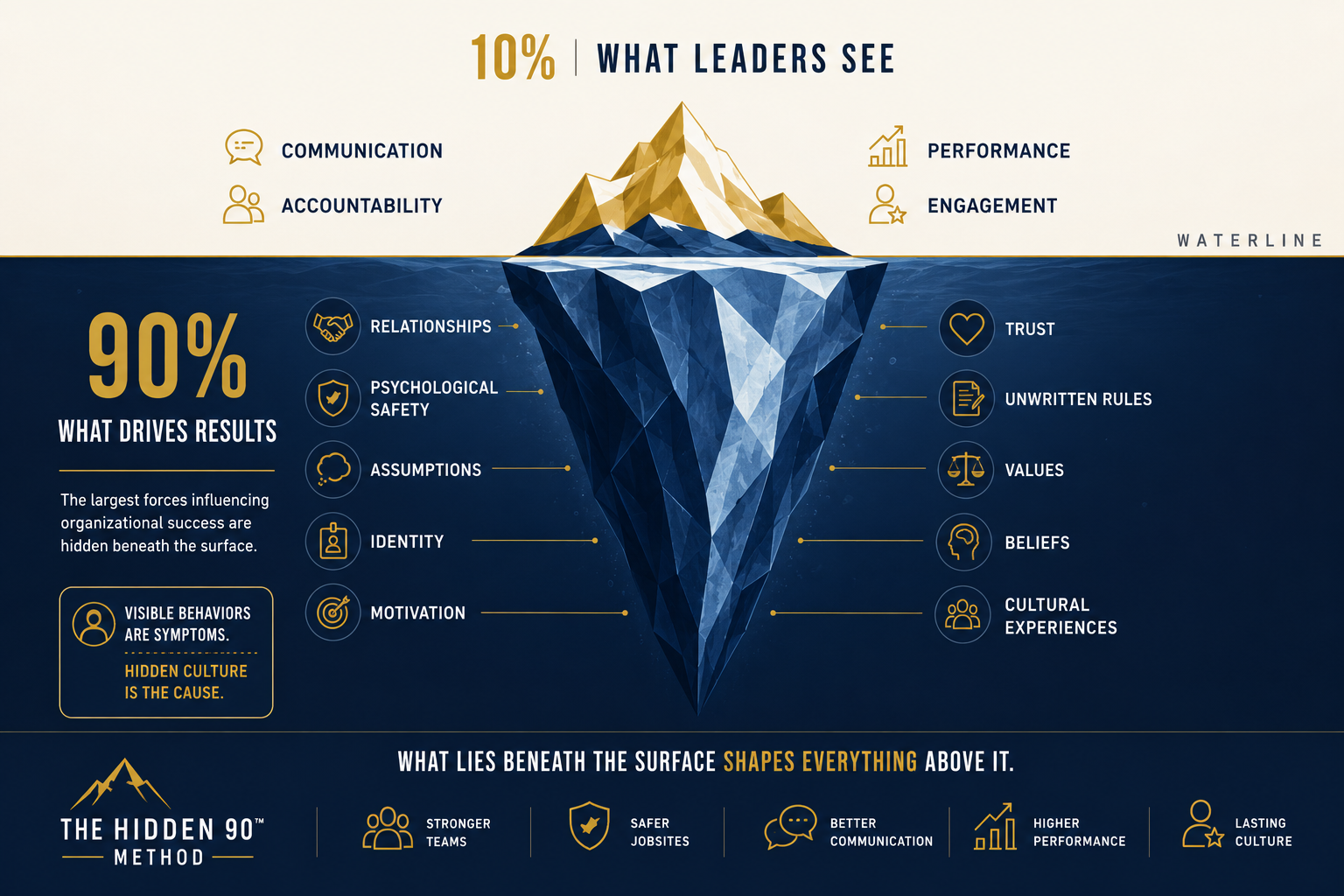
Policies, training records, PPE, and inspections are the visible side of safety.
Policies, training records, PPE, and inspections are the visible side of safety.
Beneath them are the leadership decisions, communication practices, production pressures, contractor expectations and everyday behaviors that determine whether safety systems actually work.
The Hidden 90 focuses on those underlying conditions helping organizations move beyond compliance and create greater consistency across people, projects, and operations.
CONSULTING CAPABILITIES
Practical support for organizations seeking stronger safety leadership, more consistent systems, and better field execution.
SAFETY CULTURE & LEADERSHIP
Strengthen the leadership behaviors, expectations, and accountability practices that influence safety performance.
ONBOARDING & COMPLIANCE
Develop clear onboarding processes, documentation requirements, responsibilities, and contractor expectations.
SAFETY SYSTEMS
Create practical systems for planning. training. communication, reporting. and operational consistency.
WORKFORCE TRAINING & FACILITATION
Deliver engaging training for leaders, supervisors, contractors, and frontline teams.
THE HIDDEN 90™ SAFETY CULTURE FRAMEWORK
The Hidden 90™ Safety Culture Framework provides a practical model for evaluating and strengthening the leadership and organizational systems behind safety performance. By focusing on four essential drivers—Culture, Communication, Commitment, and Competence—organizations create environments where safe work becomes the expected standard, not the exception.
-
What leaders and teams consistently believe, reinforce, and tolerate.
-
How safety-critical information moves across people, contractors, shifts, and project phases.
-
How leaders demonstrate that safety remains a priority when schedules and production pressures increases.
-
How organizations prepare, train, verify and support people to perform work safely

Jennifer Baez, PhD
Safety culture and operations consultant with experience leading organizational systems, contractor compliance, workforce development, and operational improvement within construction environments.
Her work connects the technical expectations of safety with the leadership and organizational conditions that determine how those expectations are carried into the field.
Her experience includes: contractor onboarding, vendor compliance, safety planning, incident reporting, OSHA record keeping, ISN. & Avetta compliance, training systems leadership development, and operational process improvement
CREDENTIALS:
OSHA #510 Occupational Safety and Health Standards for the Construction Industry Course
NFPA 70E Electrical Safety & Arc Flash Train-the-Trainer Certification
OSHA 30-Hour Construction
OSHA 30-Hour General Industry
7 Mobile Elevating Work Platforms
Fall Protection Train-the-Trainer
Lockout /Tarout Train-the-Trainer